BLOG
Understanding Mitsubishi Electric’s R.E.D. Cooler Chiller Technology
JULY 30, 2026
 |
by Chris Soh, Product Manager IT Cooling Systems |
Every refrigeration system contains irreversible processes that lower its overall efficiency.
Every pressure drop, heat transfer across a temperature difference, and compression and expansion process destroys a small amount of the system’s useful work potential.
In thermodynamics, this useful work potential is known as exergy. While these losses can’t be eliminated, they can be reduced through thoughtful thermodynamic design.
The R.E.D. Cooler was developed around this principle.
The R.E.D. (Reduced Exergy Depletion) Cooler is a patented refrigeration technology incorporated into Mitsubishi Electric’s air-cooled magnetic bearing chiller platform.
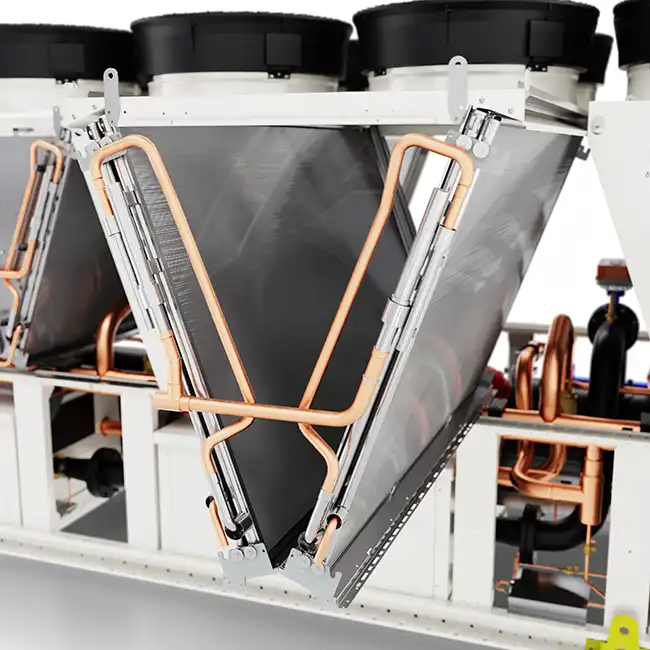
It incorporates a dedicated subcooling coil located downstream of the condenser to increase refrigerant subcooling before the expansion valve.
This reduces flash gas formation, increases the refrigeration effect, and improves cooling capacity and efficiency, particularly during high-ambient operation.
Key Terms
- Enthalpy: The amount of heat energy carried by the refrigerant.
- For refrigeration: Cooling Capacity = Mass Flow × Refrigeration Effect (Δh)
- Δh = change in enthalpy
- For refrigeration: Cooling Capacity = Mass Flow × Refrigeration Effect (Δh)
- Entropy: The measure of how useful energy has been lost due to inefficiencies.
- Exergy: The measure of useful work potential of the system.
- Subcooling: The amount by which the liquid refrigerant temperature is reduced below its saturation (condensing) temperature at the same pressure. It provides a margin to keep the refrigerant as a solid column of liquid, preventing flash gas from forming before the expansion device and ensuring stable system performance.
Introducing Exergy: The Refrigeration Cycle on a T-s Diagram
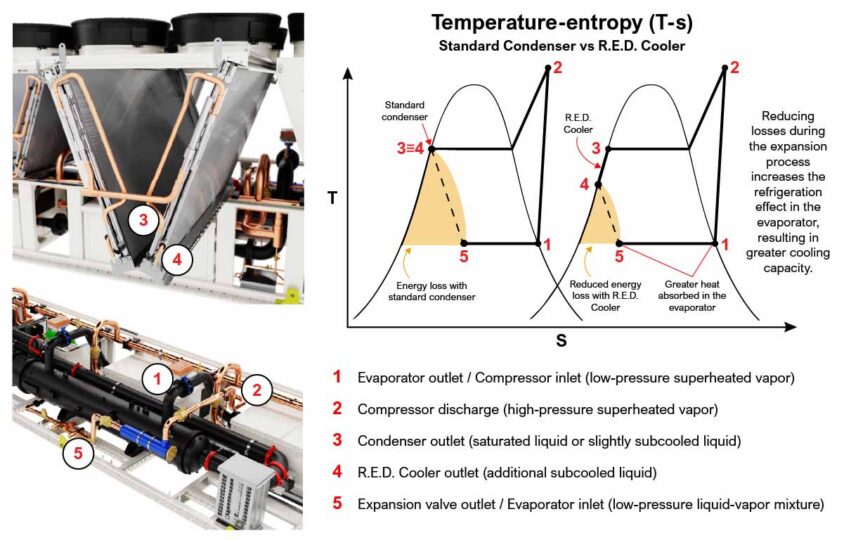
The temperature-entropy (T-s) diagram provides a useful way to visualize the thermodynamic processes occurring within a refrigeration system and where irreversible losses occur.
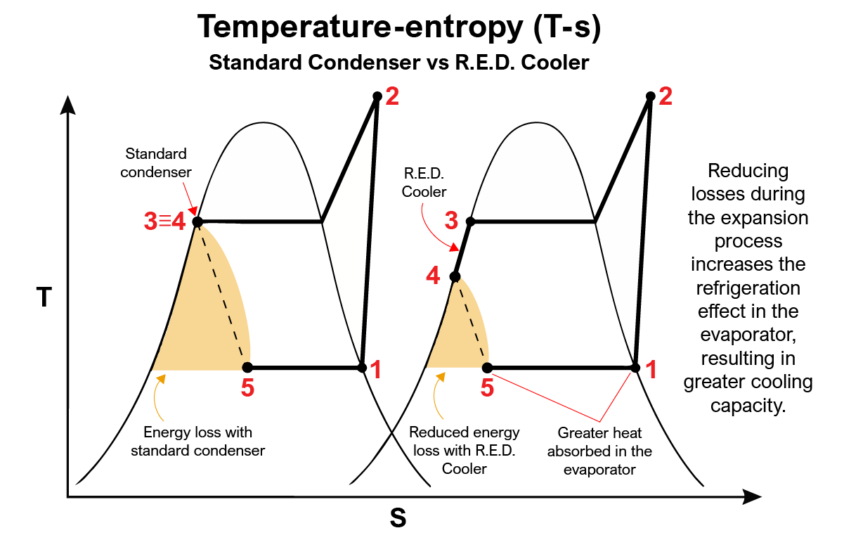
Conventional air-cooled chillers typically provide around 10–12°F of condenser outlet subcooling. Achieving higher subcooling levels generally requires additional design features such as economizer plate heat exchanger and vapor injection. Designs incorporating these features often target subcooling of around 16°F.
| State | Description |
|---|---|
| 1 | Evaporator outlet / Compressor inlet (low-pressure superheated vapor) |
| 2 | Compressor discharge (high-pressure superheated vapor) |
| 3 | Condenser outlet (saturated liquid or slightly subcooled liquid) |
| 4 | R.E.D. Cooler outlet (additional subcooled liquid) |
| 5 | Expansion valve outlet / Evaporator inlet (low-pressure liquid-vapor mixture) |
Starting at the compressor, refrigerant pressure and temperature increase before entering the condenser, where heat is rejected to the outdoor air.
Once condensation is complete, the refrigerant leaves the condenser as a high-pressure liquid and flows toward the expansion valve.
During expansion, the refrigerant undergoes an irreversible throttling process.
The shaded region in the T-s diagram conceptually represents the useful work potential (exergy) lost during this process. In the conventional cycle, limited subcooling results in greater flash gas formation and increased exergy destruction.
Because flash gas contributes little useful cooling in the evaporator, it displaces liquid refrigerant that would otherwise absorb heat. The result is a smaller refrigeration effect, reducing both cooling capacity and overall system efficiency.
How the R.E.D. Cooler Works
In a conventional air-cooled chiller, the condenser is responsible for both condensing and subcooling the refrigerant.
As the refrigerant becomes fully condensed, its temperature approaches the outdoor ambient temperature, reducing the temperature difference available for heat transfer. As a result, the condenser’s ability to provide additional rapidly diminishes.
Mitsubishi Electric’s R.E.D. Cooler overcomes this limitation by adding a dedicated liquid subcooling coil downstream of the condenser. The coil is specifically designed to maintain high refrigerant velocity by using smaller-diameter tubing.
Maintaining higher refrigerant velocity preserves the internal heat transfer coefficient, allowing the refrigerant to continue rejecting heat effectively even as its temperature approaches ambient.
Entering the expansion valve at a lower temperature reduces flash gas formation, increases the refrigeration effect, and improves both capacity and efficiency.
Returning to the T-s diagram, the additional subcooling shifts the liquid refrigerant to a lower enthalpy state before expansion. Although the throttling process remains irreversible, it generates less flash gas and results in a smaller increase in entropy.
As illustrated by the smaller shaded region, less useful work potential (exergy) is lost during expansion, allowing more of the refrigerant to remain in the liquid phase and contribute to useful cooling within the evaporator.
From Thermodynamics to System Performance
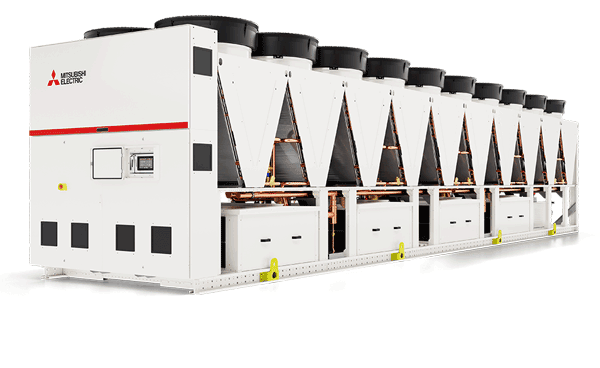
The R.E.D. Cooler is one of several technologies incorporated into Mitsubishi Electric’s MECH-iC air-cooled magnetic bearing chiller platform.
Preserving more of the refrigerant’s useful work potential allows the refrigeration circuit to produce more cooling from the same compressor, improving efficiency without increasing system complexity.
The result is a compact, high-performance chiller capable of delivering greater cooling density and dependable operation under demanding data center conditions.
Edited by Matt Slippy, Marketing Specialist & Nicole Wenger, Senior Marketing Specialist
Stay up-to-date on industry trends & insights
Get the critical power insights you need to keep your business from going dark.
By submitting this contact form, you agree that a representative(s) of Mitsubishi Electric Power Products, Inc. (MEPPI) may contact you using the information you provided. In accordance with our Privacy Policy, we will never share or sell your personal data.
Follow us on social media

