Meet Morgan
Our team members come from diverse and experienced backgrounds in electrical training, and many have been in critical power for years. We pride ourselves on choosing the best people to service our customers to ensure that you get the most out of your equipment.
Morgan Winterrose
Field Service Supervisor, IT Cooling
If there’s one theme throughout Morgan Winterrose’s career, it’s a willingness to jump into something new. From trading college classrooms for HVAC job sites, to teaching himself new skills after hours and stepping into his first leadership role, Morgan has never stopped learning. Today, he’s helping grow our IT Cooling Field Service organization while keeping a team-first attitude, a great sense of humor, aand plenty of enthusiasm for what’s next.
Certifications: 06A low voltage journeyman’s card, Universal EPA Certification, OSHA 10-hour, Daikin VRV certification, NATE Heat pump Certification, Forklift
Your HVAC field experience started back in 2015. Can you tell us about your career path and how you ended up here at Mitsubishi Electric?
“When I got out of high school, I went to college for a year, and kind of figured out I liked skiing more than going to class. So, after a year I went back, got a job at a local shop, kind of a mom-and-pop shop, and started doing the HVAC there for the summer. And that turned into a full-time job.
I started out doing installs, ductwork, hanging furnaces, and then that progressed into startups. On new construction, I was going and setting up the units, braising them in, wiring them in, and getting a kind of deeper understanding of the system.
From there I moved to maintenance. So going to customers’ houses, interacting with customers, doing maintenance on newer systems, and then from there moved into service. That’s probably the first five-ish years of my career.
When I finally got into service, I had enough hours to test for my journeyman’s license. Once I got that, it was mostly full-time service and startups, and… pretty much everything I’ve learned has been on the jobsite asking questions or, if there’s something I don’t really understand, I just hop on YouTube and watch a video until I understand it. I’m kind of lucky in that respect. I didn’t have to pay for a tech school or anything like that, but I was able to just put in the time and work to move up.
After about five years, I transferred to a bigger company, which gave me access to industrial sites and starting to move into bigger stuff. I did that for another six years. And then, last year, I was on Indeed and I saw a position for Field Service Supervisor with Mitsubishi Electric. So I threw my resume together really quickly, applied, and then wound up getting the job.”
What do you find most interesting about the data center industry vs. commercial HVAC?
“One thing they have in common is they both need their equipment backed up. And when the equipment goes down, it’s usually the worst day of the week for them.
One thing I’ve found that I really like about data center cooling and these projects is they have facility engineers and their own maintenance team, so it allows you, as a technician, to be as in-depth as you want to be with your write-ups and with how you communicate.
Our communication with customers is critical, our schedules are critical, and just keeping track of the small details is paramount for these data center customers. I’ve seen that some of that can kind of slide with residential, and it doesn’t really matter. It’s not the end of the world. So, I’d say that’s the biggest difference I’ve seen.”
What have you learned since transitioning from a technician role to a supervisor role?
“Oh, this is a good one. I like this one because I’m almost a year in now, and I’m still learning stuff every day. On the equipment side, I’m very well versed in how to fix things. So, the next progression for me was how to interact with people and build a team and manage a team. And Mitsubishi Electric offered that. So that’s what brought me here.
My favorite part about this position is I’ve gotten a lot better with communicating with people, following up with people, as well as presenting my point in a way where everybody can actually relate to it and it actually lands with people.
Those things have really been new to me because when you’re in the field for that long, most of the time you’re just working by yourself, meaning you kind of just get to do what you want to do. And as the day rolls on, as long as everything gets done, you’re cooking.
I have enjoyed the added responsibility of making sure my guys are all right and making sure they’re set up for success. It’s just been an awesome learning experience so far.”
What do you look for when hiring Field Service Technicians to support our data center cooling product line?
“It’s really important that I look for team players: people who are good at communicating, not afraid to pick up the phone, call if they have questions, and reach out to other techs to support them if needed.
When I’m hiring, I look for kind of examples of when they’ve taken pride in their work, when they’ve taken that extra step, even if nobody asked them to. And then baseline competency skills like HVAC, of course.
We’re open to taking people fresh out of school as well and pairing them with our senior technicians so they can learn on the job. Because in my opinion, if it worked for me, it can work for anybody.
With our UPS business’ blueprint, there’s so many places for advancement for the cooling technicians that we’re bringing in. It’s really not just another job, but truly is a career. I’m looking for somebody who wants to establish confidence and become an expert in what they do. And Mitsubishi Electric offers that. And so that’s normally the type of candidate I like to see.”
How would you describe your team? How would you describe the Field Service organization within Mitsubishi Electric?
“I would describe them as excellent. We’re still growing, so my favorite part is being able to see that if one guy wants to get into management, those positions are going to be available soon. If you want to become a field service engineer and work on all the difficult things – the real head scratchers – that’s something we offer as well.
I can’t say enough about how great my team is. They’re all very dedicated. I have some of the most solid guys that you could ask for. We support each other. We have people with us spread all across North America. We have people picking up the phone at midnight in Chicago to assist somebody in Portland on the West Coast. And those phones are always available. If we ever run into issues, they have no issues calling each other.
My biggest focus has been building that team camaraderie. Mitsubishi Electric makes it easy to do with our policies and what we’re able to offer. I appreciate my whole team.”
What advice would you give to a Facility Manager?
“I would say just make sure you’re keeping up with your maintenance. At some of these sites, we have over 100 units deployed. That’s 100+ opportunities for something to happen. I find my best interactions with facility managers are when we’re both being pleasant. At the end of the day, we’re both doing a job. That’s just one of my mottos: just be nice.”
Looking five years down the road, what are you most excited about for your team or Mitsubishi Electric as a whole?
“I would say the expansion. The market is definitely not slowing down. The work is there, the units have been sold, and so we just need to bring more people into MEPPI. Because I’ll be honest, it is the best place I’ve ever worked.
So, I get excited when I’m able to share whether it be with new candidates or promoting from within to fill these new roles that come available as we launch new products.
Just this year, we’re rolling out chillers, we’re rolling out fan walls, which is an amazing product that’s going to bring us into the data hall itself.”
Where did you grow up, and where are you located now?
“I grew up in Tri-Cities, Washington. It’s like the southeastern corner of Washington. It’s right where Three Rivers meet—Columbia, Yakima, and the Snake. That means lots of boating, summertime shenanigans, and all that stuff.
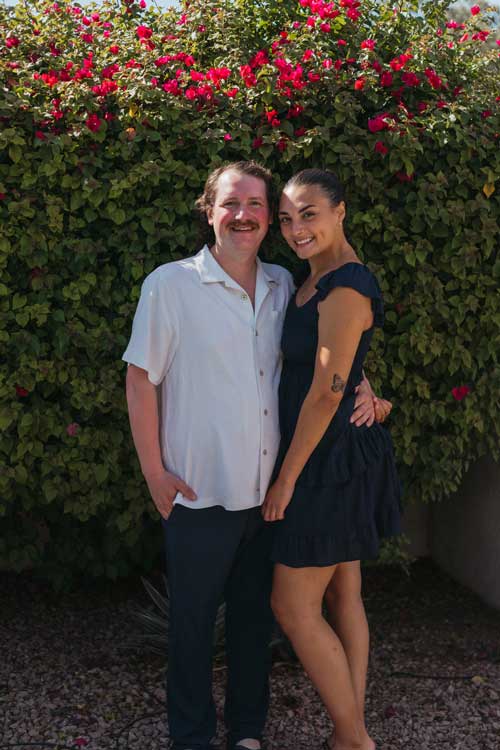
And then a month ago I moved to Arizona, met a girl, and said, ‘hey, let’s send it.’ So, I moved down here. Now, I’m out in Mesa, Arizona. But yeah, I love it out here. When it’s not 115 degrees, it’s amazing.”
What is something you are passionate about outside of work?
“I like going boating and spending time with friends. That’s kind of my main focus, just very social, hanging out with people, whether at a good brewery or just going to a bar to watch the Mariners play. I love watching them. They break my heart every year, but it’s been 21 years, so why would it ever change?
I’m not very outdoorsy but I love skiing and snowboarding. They also have a lift that takes you up the mountain – that’s more my speed.“
What is your go-to comfort food?
“Mac and cheese. And pizza. Because you can never go wrong with pizza. You can have pizza for breakfast, lunch, and dinner. It’s very versatile and same with mac and cheese. A little breakfast mac… I don’t think I’ve ever tried that, but I’d totally be down.“
Do you have a favorite movie/TV show or book?
“I grew up in the golden era of video games, I like to call it. I played a lot of Halo 3 and a lot of Modern Warfare 2. If I remember correctly, I had something like 3000 hours on Modern Warfare 2 which equates to some absurd number of days spent playing a video game.
But it was one of those things where you’d come home from school and all your buddies would be on. So, it was like you weren’t playing by yourself; you were hanging out with all your friends. So, growing up I was big into video games. And I still play from time to time, but not nearly as much.”
If you could have any superpower, what would it be and why?
“Is just being incredibly lucky a superpower? Like where everything just works out? Because I feel like that would be an amazing superpower.“
What is the best advice you have received, personally or professionally?
“I have two of them.
The first one came from one of the first senior techs I was learning from: ‘if you hear hoofs, it’s probably a horse, not a zebra.’ And so, the meaning I got out of that was start with the basics. You know, a lot of the time it’s not this elaborate problem or crazy thing going on. It’s normally something pretty average. That really helped me through my career because when you’re troubleshooting, it’s really easy to kind of break off into weird tangents.
And then the second one is it’s just the rhythm of the night. It is what it is. So just build a plan and figure out what you’re going to do moving forward and keep rolling.”
Profile Last Updated: September 25, 2026